Students who have completed their studies through the School of Open Learning at the University of Delhi may need a migration certificate when moving to another university or continuing their education at a different institution. This document helps establish that the student is leaving the previous university to pursue studies elsewhere.
If you are a DU SOL student and want to apply for a migration certificate, it is important to understand the application process, required documents and verification requirements before submitting your request.
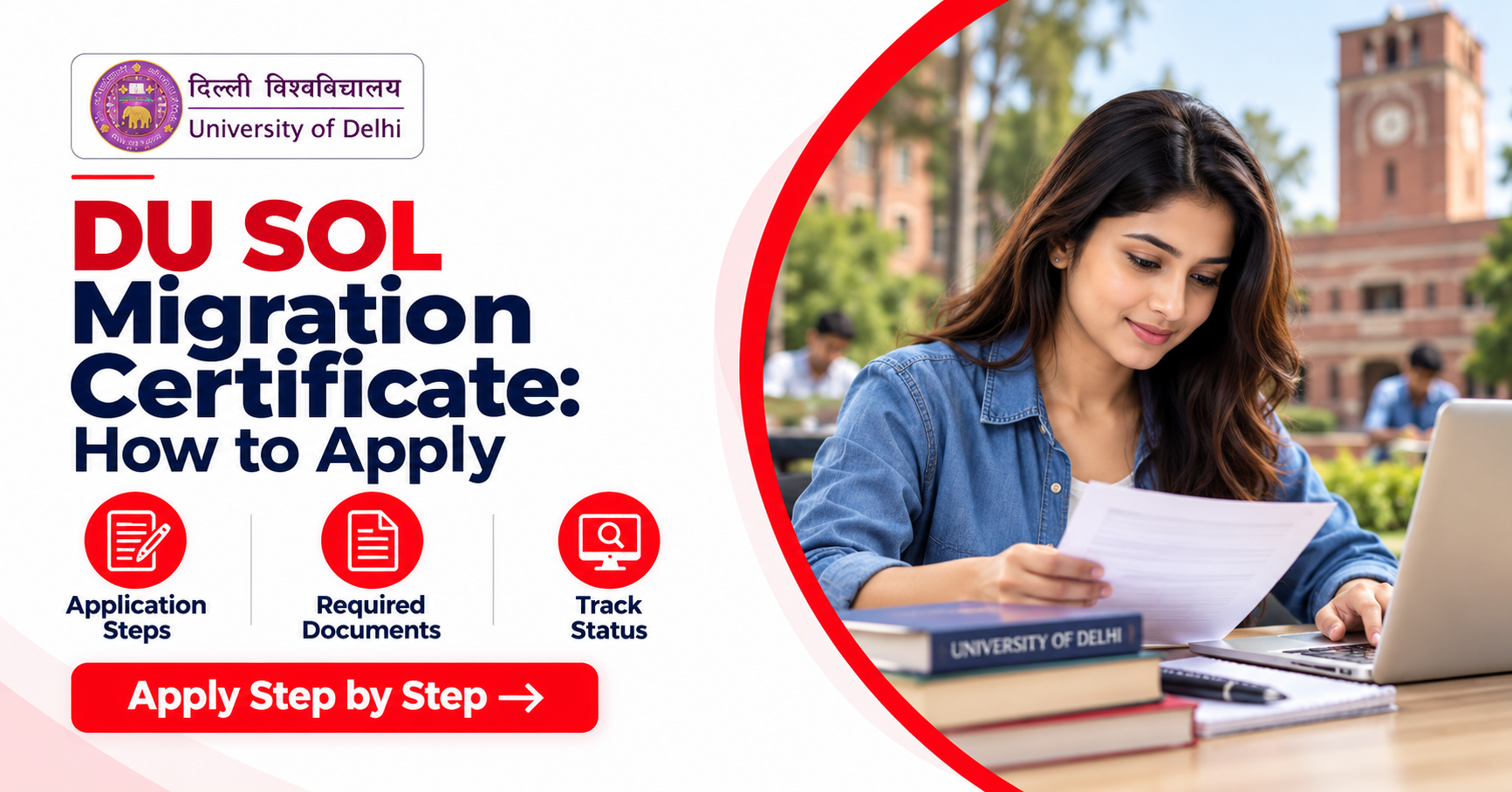
This guide explains how to apply for a DU SOL migration certificate in 2026, what documents you may need and which details you should confirm before applying.
What Is a DU SOL Migration Certificate?
A migration certificate is an official document issued by a university to a student who intends to continue their education at another university. It helps the receiving institution process the student’s admission when a migration certificate is required.
For students enrolled through DU SOL, the certificate may be needed when applying for admission to another university for a postgraduate programme or another eligible course.
However, a migration certificate is different from a degree certificate, provisional certificate, marksheet or transfer certificate. Each document serves a different purpose, so students should check exactly what the new institution requires.
Who Needs a DU SOL Migration Certificate?
A DU SOL migration certificate may be required by students who want to move from the University of Delhi to another university.
Common situations include:
- Applying for a postgraduate course at another university.
- Taking admission to a professional course that requires migration documentation.
- Continuing higher education at an institution outside Delhi University.
- Completing a programme through DU SOL and submitting academic documents to a new university.
Not every admission process requires a migration certificate. Some institutions may request only the degree certificate, marksheets or provisional certificate. Therefore, confirm the document requirements with the institution where you plan to take admission.
How to Apply for a DU SOL Migration Certificate Online
Students should distinguish between the general University of Delhi migration certificate application process and the SOL-specific no-dues verification process. Depending on the student’s admission year and academic records, additional verification may be required.
Step 1: Visit the Official DU Migration Certificate Portal
Start by checking the University of Delhi’s online migration and provisional certificate application system. Read the available guidelines before beginning the application.
Use the details recorded in your university documents so that your application matches your academic records.
Step 2: Select the Appropriate Application Option
Choose the migration certificate option and enter the requested information. Depending on the portal, you may need to provide your name, enrolment number, academic details, examination information and the university where you intend to continue studying.
Check every entry carefully before moving to the next step.
Step 3: Upload the Required Documents
Keep scanned copies of your academic documents and identity proof ready. The University of Delhi’s published migration certificate guidelines specify acceptable academic proof and identity documents.
Make sure your uploaded files are clear, complete and consistent with the information entered in the application.
Step 4: Pay the Prescribed Application Fee
Pay the fee shown on the official application portal. The amount may depend on the applicable rules and the period since the last examination passed.
Save the payment receipt and application acknowledgement for future reference.
Step 5: Complete Any Required Verification
After submitting the online application, follow the instructions provided by the portal. The University’s published guidelines include printing the application and obtaining certification from the relevant college principal, head of department or director of the institution where the student last studied.
Because SOL students may have a different administrative route from regular college students, confirm whether this certification requirement applies to your case before submitting any physical documents.
Step 6: Check the Application Status
Keep your acknowledgement number, application form and payment receipt safe. Check the official portal or contact the relevant University of Delhi or SOL office if your application remains pending.
If additional documents or verification are requested, submit them according to the instructions provided by the university.
Documents Required for a DU SOL Migration Certificate
The exact requirements may depend on your student category and the instructions applicable to your application. Prepare the following documents where relevant.
| Document | Purpose |
|---|---|
| Final-year marksheet or statement of marks | Proof of academic completion |
| Degree certificate | Academic qualification proof, if already issued |
| Provisional certificate | Alternative academic proof where accepted |
| Aadhaar card, voter ID or passport | Identity verification |
| Application form | Record of your migration request |
| Fee receipt | Proof of application payment |
| Enrolment or roll number details | Helps identify your academic record |
| Receiving university details | May be requested to record the purpose of migration |
The University’s published guidelines list a degree certificate, final-year statement of marks or provisional certificate as academic proof options. They also list identity documents such as Aadhaar, voter ID, driving licence, PAN card or passport.
Do not upload every document indiscriminately. Follow the requirements displayed for your application category.
DU SOL Migration Certificate Fees
The University of Delhi’s published migration certificate guidelines list the following fee structure. Students should verify the amount shown on the live portal before making payment, as published guidelines may be revised.
| Application category | Fee listed in the published guidelines |
|---|---|
| Required for use in India, within 10 years of the last examination passed | ₹500 |
| Required for use in India, more than 10 years after the last examination passed | ₹1,000 |
| Required for use abroad, within 10 years | US$50 |
| Required for use abroad, more than 10 years later | US$100 |
These figures are based on the University’s published migration certificate guidelines and should not be treated as a guarantee of the current payable amount for every SOL student.
The fee displayed by the official application system and any instructions issued for your student category should take priority.
Is SOL No-Dues Verification Required?
Some DU SOL students may need to complete a no-dues or clearance process before obtaining academic documents.
The SOL library’s online no-dues facility includes options relating to no-dues verification, degree and migration certificates. Its published eligibility note refers to specific admission-year and course-completion categories.
This means that the process may differ depending on when you enrolled and when you completed your course.
Before applying, check whether your admission year falls within the categories supported by the no-dues portal. If your records do not fit the listed criteria, contact the SOL office to confirm the correct procedure rather than submitting an application under an incorrect category.
How Long Does It Take to Get a DU SOL Migration Certificate?
The processing time can depend on document verification, the completeness of your application and whether additional clearance is required.
Students should avoid assuming that the certificate will be issued within a fixed number of days unless the university has published a specific timeline for their application category.
To avoid unnecessary delays, enter your enrolment details correctly, upload readable documents, retain the fee receipt and respond promptly to any verification request.
If you need the certificate for an upcoming admission deadline, begin the process early and ask the receiving university whether it accepts an acknowledgement or another temporary document while the migration certificate is being processed.
Common Mistakes to Avoid
Students can reduce the risk of application delays by avoiding these common mistakes:
- Entering an incorrect enrolment or examination number.
- Uploading incomplete or unreadable documents.
- Selecting the wrong application category.
- Assuming that a degree certificate and migration certificate are interchangeable.
- Ignoring SOL-specific no-dues requirements where applicable.
- Paying through an unofficial website or agent.
- Waiting until the receiving university’s admission deadline to begin the process.
Always use the official University of Delhi or SOL application system and keep a copy of every document submitted.
Conclusion
Applying for a DU SOL migration certificate involves selecting the correct application option, providing academic and identity documents, paying the prescribed fee and completing any required verification.
The important point is that SOL students should confirm whether they need to follow the general University of Delhi migration certificate process, complete an SOL-specific no-dues step or satisfy both requirements. The applicable process can depend on the student’s admission year and academic records.
Before submitting your application in 2026, review the latest official instructions and check the receiving university’s document requirements. This will help you prepare the correct paperwork and avoid delays during your next admission.
Frequently Asked Questions
1. How can I apply for a DU SOL migration certificate?
Start by checking the University of Delhi’s online migration certificate application system. Complete the relevant form, upload the requested documents, pay the prescribed fee and follow any verification instructions applicable to your SOL student category.
2. Is a migration certificate necessary after completing DU SOL?
It depends on the admission requirements of the university where you want to study next. Some institutions require a migration certificate, while others may request different academic documents.
3. What documents are required for a DU SOL migration certificate?
Commonly accepted academic proof includes a final-year marksheet, degree certificate or provisional certificate. Identity proof and other documents may also be required according to the official application guidelines.
4. What is the DU SOL migration certificate fee in 2026?
The University’s published guidelines list fees based on whether the certificate is required in India or abroad and how long it has been since the last examination passed. Check the live portal for the current amount applicable to your case.
5. Can I apply for a migration certificate online?
The University of Delhi provides an online application system for migration and provisional certificates. SOL students should check whether additional SOL-specific clearance or physical verification is required.
6. Is a DU SOL migration certificate the same as a degree certificate?
No. A degree certificate confirms the qualification awarded after completing a programme. A migration certificate supports the process of moving to another university when required.
7. Is no-dues verification compulsory for every DU SOL student?
The requirements may vary by admission year and academic records. Check the SOL no-dues facility and confirm the process with the relevant office if your student category is not covered by the online facility.
8. How can I check my migration certificate application status?
Keep your application acknowledgement or reference number and use the official portal’s available status or login facility. If the status is unclear, contact the relevant university office with your application details.
9. Can I get a migration certificate if I completed DU SOL several years ago?
Students who completed their course in earlier years may still be able to apply, subject to the University’s applicable rules and verification requirements. The fee and supporting documents may depend on the time since the last examination passed.
10. What should I do if my migration certificate is delayed?
Check whether your application is complete, retain the acknowledgement and payment receipt, and contact the relevant University of Delhi or SOL office. If another university has an approaching admission deadline, ask its admissions department whether alternative documentation can be accepted temporarily.