Many students choose the School of Open Learning at Delhi University because it offers flexibility and allows them to study without attending regular college classes every day. However, after starting their degree, some students want to move to a regular college for a more traditional campus experience, classroom learning, and greater participation in college activities.
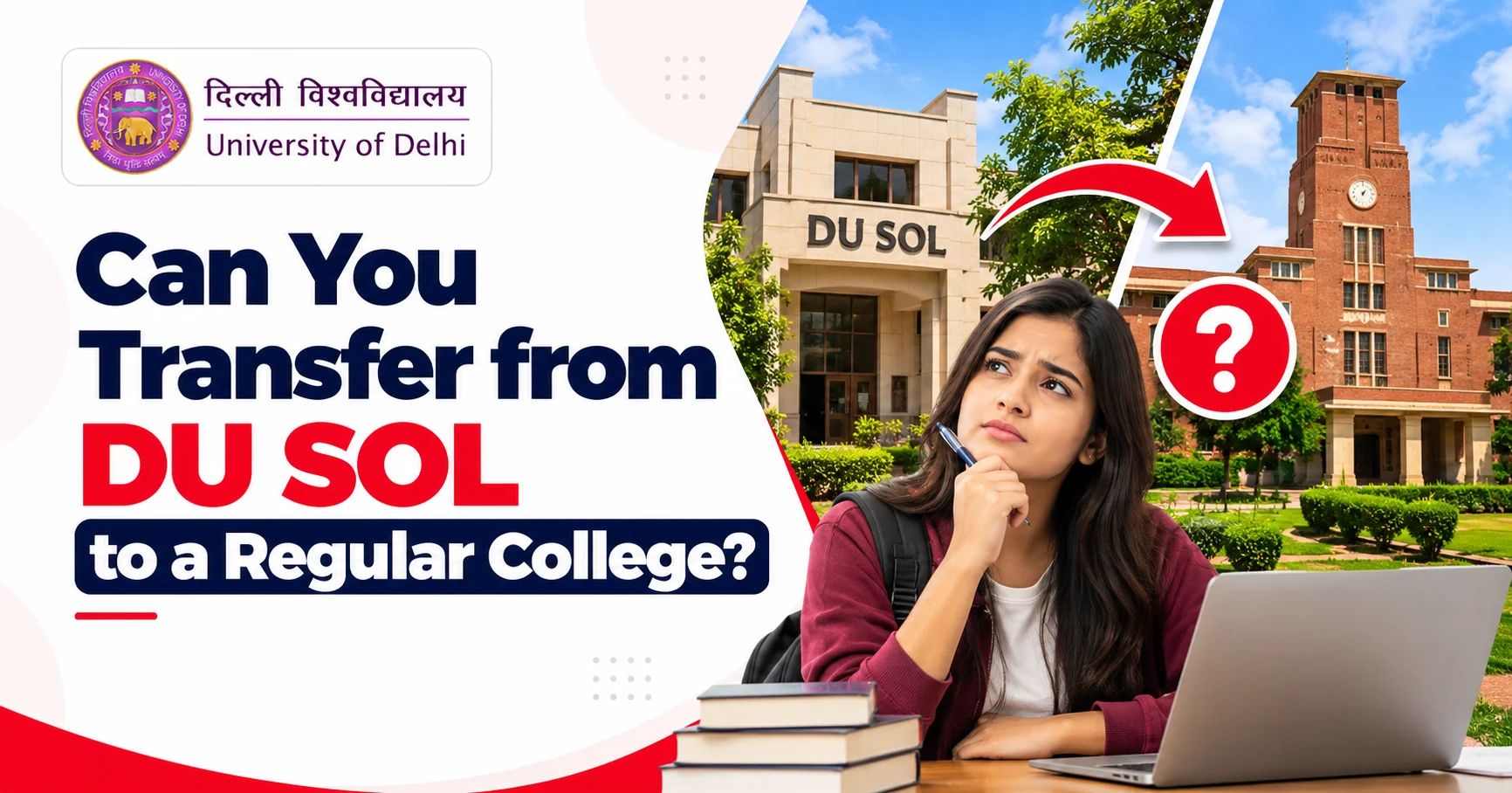
This raises an important question: Can you transfer from DU SOL to a regular college?
The answer depends on the University of Delhi’s applicable migration rules, your course, the semester you are studying in, and whether the receiving college permits the transfer. Migration should not be treated as an automatic right, and students should confirm the current rules with DU SOL and the college they wish to join.
In this guide, we explain the migration process, eligibility conditions, documents, possible alternatives, and important points to consider before making a decision.
Can You Transfer from DU SOL to a Regular College?
Students enrolled in DU SOL may explore migration to a regular college under the University of Delhi’s applicable rules. However, approval is not guaranteed, and the process can depend on the student’s circumstances and the receiving college’s requirements.
The DU SOL undergraduate prospectus for 2025–26 describes inter-college migration provisions for undergraduate programs under the semester system. These provisions refer to migration at the beginning of the third semester, subject to conditions such as seat availability and the consent of the principals concerned.
However, students should not assume that these general provisions automatically guarantee a transfer from every SOL program to a regular college. You should obtain confirmation of the current procedure for your particular course and admission year.
Important points to understand
- Migration is subject to the university’s applicable rules.
- The semester in which you apply matters.
- The receiving college must have a seat available, where required.
- Approval from the relevant authorities may be necessary.
- Your existing course and academic record may affect your application.
- The deadline and required documents must be confirmed for the current academic session.
If you are planning to move from DU SOL to a regular college in 2026, contact both DU SOL and your preferred college before making any changes to your existing admission.
DU SOL to Regular College Transfer Rules
The University of Delhi has published migration provisions under its university ordinances. The DU SOL undergraduate prospectus includes conditions relating to undergraduate migration.
The following table summarises the main points students should investigate.
| Migration Factor | What Students Should Know |
|---|---|
| Semester | The published provisions refer to migration at the beginning of the third semester |
| Course | The rules applicable to your particular undergraduate program must be checked |
| Seat availability | Migration may depend on an available seat in the receiving college |
| College approval | Consent from the relevant principals may be required |
| Academic record | Semester results and course requirements may be considered |
| Application deadline | The current deadline must be confirmed with the university |
| Documents | Marksheets, application documents, and any required NOC or certificates may be needed |
These are general points based on the published migration provisions. They should not be interpreted as confirmation that every DU SOL student is eligible to move to a regular college.
Who Can Apply for Migration from DU SOL?
Your eligibility depends on the applicable university rules and your individual academic situation.
1. Students who have completed the first year
If you have completed the first year of your undergraduate program, you may ask whether migration is available for your course under the current rules.
The published migration provisions refer to the beginning of the third semester, but completing the first year alone does not guarantee approval.
2. Students pursuing BA or B.Com
Students enrolled in BA or B.Com programs should confirm the rules for their specific degree and curriculum. The university’s migration provisions may depend on the program structure and the applicable academic regulations.
Do not assume that the procedure for one course automatically applies to another.
3. Students with declared semester results
Your academic record may be important when your migration application is considered. Keep your available marksheets and examination records ready.
If your results are pending, ask the university whether you can apply or whether you must wait until the required results have been declared.
4. Students who want to change their study mode
Moving from an open learning program to a regular college involves a change in study mode. The university must determine whether your requested transfer is permitted under its rules.
Students should not discontinue their existing studies until they receive clear guidance about the transfer and its consequences.
How to Transfer from DU SOL to a Regular College
If you want to explore migration, follow these steps before submitting an application.
Step 1: Contact the regular college
Identify the regular DU college you wish to join and contact its administration or principal’s office.
Ask whether it accepts migration applications from DU SOL students for your course and semester. Also ask about seat availability and the applicable eligibility conditions.
Step 2: Check the current DU migration rules
Review the latest migration provisions issued by the University of Delhi and the instructions provided by DU SOL.
Confirm the eligible semester, application deadline, course restrictions, and required approvals. Older admission information may not reflect the rules for the current academic session.
Step 3: Check your academic results
Keep copies of your available semester marksheets and other academic records.
Ask whether you must pass particular examinations or meet any additional academic requirements before your application can be considered.
Step 4: Ask about the No Objection Certificate
A receiving college or the university may require a No Objection Certificate, or NOC, as part of the migration process.
Confirm the correct format and the authority that must issue or approve it. Do not assume that obtaining an NOC alone guarantees migration.
Step 5: Submit the required application
Follow the application procedure communicated by the university and the relevant colleges. Submit the requested documents within the specified deadline.
Keep copies of the application, acknowledgements, and any written communication.
Step 6: Wait for official approval
Do not consider the transfer complete until the relevant authorities have approved it and provided instructions for completing the process.
Ask for written confirmation of your new admission status, course registration, and any applicable academic or administrative requirements.
Documents Required for DU SOL to Regular College Migration
The documents required may vary depending on the course and the university’s current instructions.
Students may be asked to provide:
- DU SOL admission or enrolment details
- Semester marksheets or examination results
- Student identity proof
- Migration application form
- No Objection Certificate, if required
- Academic records relating to the current course
- Other certificates or documents requested by the university
Before submitting original documents, confirm whether the receiving college needs originals, self-attested copies, or digitally uploaded records.
Can You Transfer from DU SOL to a Regular College in the Second Year?
The second year is an important stage because the published University of Delhi migration provisions refer to migration at the beginning of the third semester.
However, this does not mean that every student who has completed the first year can automatically enter the second year of a regular college.
Your application may depend on the applicable migration rules, course structure, academic results, availability of seats, and the approval of the relevant authorities.
If you have completed your first year at DU SOL, contact the receiving college and DU SOL to establish whether migration is currently permitted for your program.
Can You Transfer from DU SOL to a Regular College in the Third Year?
You should not assume that you can move directly into the third year of a regular college.
The published migration provisions refer to the beginning of the third semester, which is different from the beginning of the third year. Migration rules may also restrict the stage at which a transfer can take place.
If you are already in the third year, ask the university whether any applicable provision allows your requested transfer. Obtain confirmation before relying on an informal assurance.
What If Your DU SOL Transfer Application Is Rejected?
If migration is not permitted or your application is unsuccessful, you still have other ways to continue your education.
Option 1: Complete your degree through DU SOL
If your primary goal is to obtain a bachelor’s degree, continuing with DU SOL may allow you to complete your current program without restarting your studies.
You can explore internships, skill-development courses, professional certifications, and other opportunities alongside your degree.
Option 2: Apply for fresh admission to a regular college
You may investigate applying for admission to a regular undergraduate program as a new student, subject to the university’s admission process and eligibility requirements.
For Delhi University regular undergraduate admission, candidates generally need to follow the applicable CUET and Common Seat Allocation System requirements for the relevant admission year.
Fresh admission is different from migration. You should confirm whether previous credits can be recognised rather than assuming that you will automatically enter the second or third year.
Option 3: Complete graduation and apply for postgraduate study
Another option is to complete your bachelor’s degree through DU SOL and then apply for a postgraduate program at a regular college.
Admission will depend on the postgraduate program’s eligibility requirements, entrance examination rules, and selection criteria.
This route allows you to finish your existing qualification before exploring a regular campus-based postgraduate program.
DU SOL vs Regular College: What Is the Difference?
Before deciding whether to transfer, consider the differences between the two learning environments.
| Factor | DU SOL | Regular College |
|---|---|---|
| Learning format | Open and distance learning | Primarily campus-based learning |
| Classroom attendance | Flexible, according to program requirements | Regular classes according to the timetable |
| Campus experience | Different from a conventional regular college | Greater access to routine campus activities |
| Study schedule | More independent learning | More structured class schedules |
| Peer interaction | Depends on available learning activities | Regular interaction with classmates |
| Migration | Subject to applicable rules | Transfer out is also subject to applicable rules |
Neither mode is automatically better for every student. Your decision should depend on your learning preferences, career plans, personal circumstances, and the requirements of your chosen course.
Is a DU SOL Degree Valid If You Cannot Transfer?
Students should not assume that a DU SOL degree is inferior simply because it is earned through open and distance learning.
The validity of a qualification depends on the institution’s status, the program’s applicable recognition, and the rules governing the relevant academic session.
If you cannot migrate to a regular college, you can still focus on completing your degree and developing skills relevant to your intended career.
For postgraduate admissions or employment, check the eligibility criteria of the specific university, employer, or recruitment authority. Additional requirements may apply depending on the role or course.
Important Tips Before Applying for Migration
Before starting the process, keep these points in mind:
Confirm the rules for your course. Migration conditions may vary according to the degree and applicable academic regulations.
Contact both institutions. Ask DU SOL and the receiving college for clear instructions.
Check the deadline. Do not rely on a deadline from an older academic session.
Keep your academic documents ready. Marksheets and enrolment details may be needed to assess your request.
Do not cancel your current admission prematurely. Wait until you understand the consequences and have received official guidance.
Get important decisions in writing. Written confirmation can help you avoid confusion about eligibility, approvals, and your admission status.
Conclusion
Transferring from DU SOL to a regular college may be possible only when the applicable University of Delhi migration rules permit it and the required conditions are satisfied. The published DU SOL undergraduate prospectus refers to migration at the beginning of the third semester, subject to conditions such as seat availability and the consent of the relevant principals.
However, this should not be treated as a guarantee that every SOL student can move to a regular college. Eligibility, deadlines, and procedures must be confirmed for the particular course and academic session.
If migration is unavailable, students can consider completing their DU SOL degree, applying afresh for regular admission, or pursuing postgraduate education at a regular college. The most important step is to obtain accurate guidance from the university before making a decision.
Frequently Asked Questions
1. Can I transfer from DU SOL to a regular college?
Migration may be possible under applicable University of Delhi rules, but it is not guaranteed for every student or course. Confirm the current conditions with DU SOL and the receiving college.
2. Can I transfer from DU SOL to a regular college in the second year?
The published migration provisions refer to the beginning of the third semester. However, eligibility depends on the course, current rules, seat availability, and required approvals.
3. Can I transfer from DU SOL to a regular college in the third year?
Do not assume that third-year migration is permitted. The rules refer to a specific semester, so ask the university whether your requested transfer is allowed.
4. Is an NOC required for DU SOL migration?
A No Objection Certificate may be required, depending on the applicable procedure. Confirm who must issue it and which format the university accepts.
5. Can BA students migrate from DU SOL to a regular college?
BA students should check the migration provisions applicable to their particular program and curriculum. Approval depends on the university’s rules and the receiving college’s requirements.
6. Can B.Com students transfer from DU SOL to a regular college?
B.Com students should contact DU SOL and the receiving college to confirm whether migration is available for their course, semester, and admission year.
7. What documents are required for DU SOL migration?
Possible documents include enrolment details, semester marksheets, a migration application, identification, and an NOC if required. The university will confirm the exact list.
8. What happens if my DU SOL migration application is rejected?
You can consider continuing your degree through DU SOL, applying for fresh admission to a regular college under the relevant admission process, or completing graduation and applying for postgraduate study.
9. Can I get direct admission to the second year of a regular DU college after studying at SOL?
Direct entry into the second year is not guaranteed. It depends on the applicable migration rules and the decision of the university and receiving college.
10. Whom should I contact to confirm DU SOL migration rules?
Contact the official DU SOL administration and the principal’s or admissions office of the regular college you want to join. Ask for the current migration procedure, eligibility criteria, and deadline.